Grace Shipway is a senior property manager at Charter Hall. But when she’s out of the office, she’s a tenacious sailor facing the most brutal waves. And this is no metaphor – it’s raw, open-ocean reality.
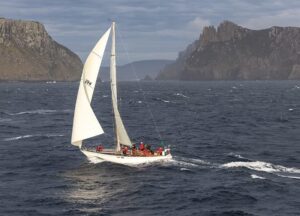
Grace recently completed the Rolex Sydney to Hobart Yacht Race, one of Australia’s most demanding sporting events. After four gruelling days offshore, she steered her boat, Love & War, across the finish line.
We sat down with Grace to hear her story – and discover what she’s learned about performing under pressure.
A goal years in the making
Grace Shipway has been sailing since she was five, training with her father in Sydney Harbour.
For over two decades, she would watch as the Sydney to Hobart race began on Boxing Day. And every year, she’d think: One day, I’ll be in that race.
That one day finally came in 2025.
‘It was the 80th year of the race, so it’s a bit more of a spectacle,’ Grace recalls. ‘And I just thought, this year felt right. It was time for me to do it.’
But why this race in particular? Besides the fact that it’s one of the most iconic ocean races within the sailing community, Grace explains, it’s also one that her father had completed before. Thirty-one times.
‘My dad is a highly respected yachtsman himself, and he’s inspired me to do it. Plus, if he could do it 31 times, I’m sure I can at least do one.’
Then, after a short pause, Grace adds with a smile, ‘Though I’d love to beat his record!’
Preparing for the uncontrollable
From the moment she decided to do the race, Grace knew she had to go all in.
And that meant saying yes – repeatedly. To harbour racing. Coastal racing. Offshore races. Weekends. Afternoons after work. Any opportunity to get on as many boats as possible, in as many conditions as possible.
She also focused on physical endurance, not because it was mandatory, but because she wanted to be the best that she could be, physically and mentally. And that includes completing safety-at-sea and survival training.
‘Going into a race like this, you’re very aware there are elements you can’t control, like the wind and waves and swell,’ she says. ‘So you need to prepare for everything you can.’
Grace’s preparations spanned almost a year. But it was only on race day that they were told about the severe conditions expected in the first 48 hours.
Did she, at any point, doubt that she could do this?
‘I was pretty nervous,’ Grace admits, ‘but I was never wanting to pull out. If anything, it excited me, and I couldn’t wait to get on with it.’
Holding course under pressure
Once offshore, life on board Love & War ran on a strict rhythm: three hours on, three hours off. Sleep was fractured. Meals were often missed. The boat was constantly moving – pitching, rolling, demanding attention.
But the hardest moments came at night.
‘It’s dark, and you’re cold, wet and tired,’ Grace says. ‘You’re also sleep-deprived and sometimes seasick, out on the ocean with no other boats around you… just your thoughts.’
And yet, that was when Grace learned most about herself.
‘I was surprised by how calm I became,’ she reflects. ‘I was concerned that the chaos and challenging conditions would frighten me. Instead, I was able to put that to the side and focus on one thing: getting the boat to Hobart.’
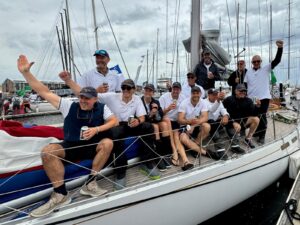
That calm was reinforced by the crew around her – 10 other sailors with a combined Hobart experience of more than 150 races.
‘Knowing that I was in safe company eased a lot of those nerves,’ Grace says. ‘They never raised their voices, and were always patient and supportive. It was a very professional crew.’
By the end of the race, something had changed within Grace.
‘Going into it, I doubted myself and how much I really knew. But by the end, my confidence had grown. I realised I actually did have this. I had what it took to do the work.’
Performance over perception
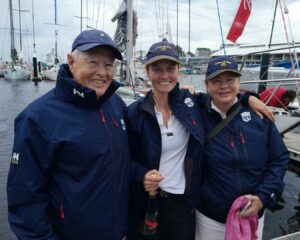
Grace was the only woman on the crew – and the first female to ever sail on board Love & War. Did that bring its own set of pressure and expectations?
‘There was quite a bit of attention on the fact that I’m the first female on such a prestigious boat,’ Grace admits. ‘But once I started racing, for me it became more about competence and performance rather than gender.’
Grace was clear she didn’t want any special treatment. She didn’t want expectations lowered or language toned down. She just wanted business as usual and the focus on the race.
‘In offshore sailing, the ocean doesn’t really care about who you are. It only cares about the job performance. So it doesn’t matter whether you’re a woman or a man – you’ve just got to get from A to B.’
After 4 days, 1 hour and 15 minutes at sea, Love & War crossed the Hobart finish line, with Grace at the steering wheel. It was a significant moment, as her father had sailed the same boat to victory in the 1974 and 1978 races.
‘It’s a boat with extraordinary legacy,’ she tells us. ‘Being part of that – and contributing to it – is something I’m incredibly proud of.’
Offshore lessons, onshore impact
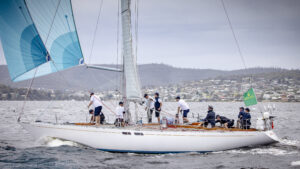
Grace approaches sailing the same way she approaches her career: with intention, planning and discipline.
Offshore racing sharpens decision making under pressure. It demands resilience. Reinforces the importance of teamwork and preparation. And rewards those who stay calm when conditions are at their worst.
‘These experiences feed into each other,’ Grace says, when asked about balancing her work and passion. ‘They make me better – onshore, offshore, and in everyday life.’
If there’s one belief that’s helped Grace succeed – both in the water and at work – what would it be?
Her answer came immediately.
‘You don’t have to feel 100% ready. You just have to be willing. Confidence isn’t something you wait for. It’s something you earn by showing up, doing the work, and staying when things get hard.’
Want to read more about inspiring women blazing trails in the industrial sector? Follow WIN on LinkedIn.